
AI can help a roofing contractor organize a supplement file, compare supplied estimate details, and flag missing or unclear records. It cannot decide what a policy covers, establish the cause of roof damage, or make up a code citation. Ask it to preserve source facts, show uncertainty, and return questions for a qualified person to check.
Key takeaways
- Ask AI to sort or compare information you provide, not to invent missing facts.
- Tell it to preserve dates, units, labels, and estimate values exactly as written.
- Use the original photo, measurement, estimate, or source to verify every flag.
- Check state rules before speaking or acting on a homeowner’s behalf.
- Keep the final decision with the person who is qualified and authorized to make it.
Can AI draft and compare a roofing supplement?
It can turn your notes into a readable draft, as long as you provide the facts and review every sentence. Ask for a neutral summary that identifies the item for review, the related estimate line, the supporting record, and any question that remains open.
Don’t ask it to make the request sound certain when the evidence isn’t. A polished paragraph can hide a weak file just as easily as it can make a good one easier to read. Keep statements about what a photo shows separate from conclusions about the cause of damage or insurance coverage.
How can AI help with a letter?
Try this narrow instruction:
Draft a short request for a human reviewer using only the facts below. For every requested item, include its estimate description, roof area, quantity and unit as supplied, supporting document, and an open question if information is missing. Do not claim coverage, cause, entitlement, compliance, or payment. Do not add a fact. Mark every statement that needs source review. Records: [insert approved, redacted excerpts].
Then compare the draft line by line with the originals. If the model changed a quantity or left out a qualifier, fix it before anyone else reads it.
How can AI compare an estimate?
It can flag a difference between a supplied scope and estimate. That is a lead to review, not proof that the scope is correct or that a policy covers the item.
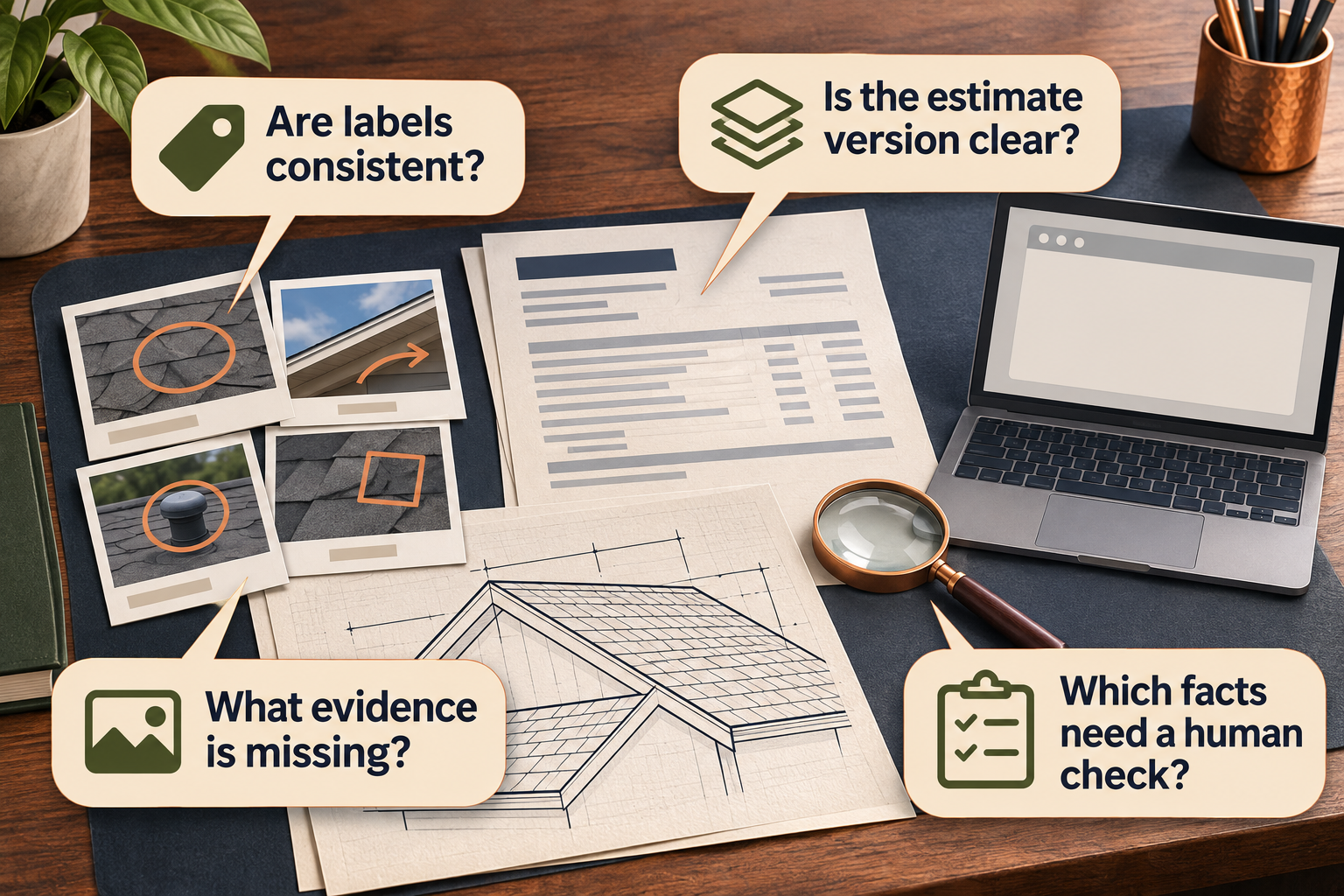
Give the tool both files or redacted excerpts. Tell it to compare matching roof areas and preserve the units. Ask it to return the exact source text beside each flagged difference. If the files use different labels, units, or versions, the model should say that it cannot match them.
| Question for AI | Useful output | What a person still verifies |
|---|---|---|
| Which scope rows have no obvious estimate match? | Candidate rows and the text it compared | Whether the item belongs in the actual scope |
| Which quantities or units differ? | The values exactly as supplied | Measurement method, calculations, and correct units |
| Are the estimate versions identified? | Dates or version labels found in each record | Which version is current for this review |
| Which entries use different roof-area names? | A list of inconsistent labels | Whether two labels refer to the same physical area |
| What evidence is missing from the index? | A list of absent or unclear file references | Whether the file exists and should be included |
Never let the prompt turn a comparison into a coverage opinion, price recommendation, or payment demand. Keep the question focused on what the records say.
Which questions should you ask about roof photos?
Ask the model to check whether photo captions include a date, roof area, sequence, and factual description. It can identify missing labels in a photo list. It can’t establish from a caption alone that the image shows the right property or proves a particular cause.
Use a prompt like this:
Review these permitted photo captions and the roof-area list. Return each filename, date if stated, area label, description, and any missing or conflicting field. Preserve every label exactly. Do not infer the location from the image, diagnose damage, or state what caused it. Mark anything that needs a person to compare with the original photo. Captions: [insert approved list].
Open the actual image after the review. Confirm that its caption matches what it shows. If the photo is unclear, mark it unclear rather than asking the model to make it persuasive.
The NAIC recommends documenting property damage with photos or video and keeping repair receipts. See its homeowners claim guidance. For a flood-recovery example of photo and receipt records, FEMA’s damage documentation guidance is useful, but it is not a roofing standard.
Can AI tell whether a storm caused roof damage?
No. It may describe visible features in an image, but it cannot reliably establish when or how the roof condition occurred. A qualified inspection and the underlying records matter.
Keep separate fields for the observation, source, date, and question for the person responsible. Avoid turning “shingle edge appears raised in photo 12” into “storm damage” unless a qualified person has made that conclusion based on the right evidence.
Can AI interpret a policy or decide what’s covered?
No. Policy terms, exclusions, limits, deductibles, and claim decisions belong to the insurer and the policyholder’s qualified advisers. A language model does not know the complete contract or the full facts of the loss.
If a homeowner asks what a policy phrase means, point them to their insurer or agent. The NAIC says policyholders should contact their insurance company or agent with claim questions and keep the claim information and paperwork. The AI can organize a list of questions for that conversation. It should not answer those questions as though it were the insurer.
Can a roofer file or negotiate a claim for a homeowner?
That depends on state law, the contractor’s role, and the exact work being done. Don’t assume the rule is the same everywhere. Check the relevant state’s insurance department before offering to submit a claim, interpret a policy, or negotiate on a policyholder’s behalf.
For example, the Texas Department of Insurance says Texas does not allow a roofer or contractor who is also doing the work to act as a public insurance adjuster on the claim. Florida’s Department of Financial Services says a contractor cannot interpret policy provisions or offer coverage advice unless also licensed as a public adjuster, and its FAQ addresses other contractor restrictions. Those are state-specific examples, not nationwide rules. Review the Texas Department of Insurance guidance and Florida DFS contractor FAQs, then check your own jurisdiction.
AI cannot decide whether a task crosses a licensing line. Ask a licensed professional or regulator when you are unsure.
Can AI check a code or manufacturer citation?
It can format a citation or compare the details you supply, but it cannot be your source of authority. For a building code, verify the local jurisdiction, adopted edition, section, and any applicable building department guidance. For a manufacturer instruction, check the exact product and current document revision.
Ask the model to flag missing source details. Then open the official document and confirm that the cited language applies to the material and work in front of you. If you cannot verify it, say so.
How should AI help when an item is disputed or denied?
Use it to organize the written response, list the unresolved questions, or put the dates and documents in order. Don’t ask it to decide whether a denial is valid or tell you what the insurer must pay.
The NAIC advises policyholders who disagree with a settlement to ask for a denial in writing, keep the paperwork, and contact the insurer with their reasons. If they’re not satisfied, they can contact their state insurance department. See NAIC’s settlement guidance. A contractor can help the homeowner understand the work records, while policy questions should go to the people authorized to answer them.
Illustrative example (not a real case)
A fictional file includes two estimate versions, 14 photos, and a sketch. The draft uses “rear slope.” The photo list says “north face.” Those round numbers are invented. An AI review flags the label mismatch and notes that one estimate has no visible revision date. The estimator checks the original files, asks which estimate is current, and updates the index. The tool does not decide what should be paid.
What should you ask before you use the AI draft?
- Did the model preserve every recorded value, unit, date, and label?
- Can you trace each sentence to a source document?
- Did it flag missing details instead of filling them in?
- Does the request distinguish facts from questions and conclusions?
- Did you remove personal details the AI service does not need?
- Has the right person reviewed code, licensing, policy, and safety questions?
If any answer is no, hold the draft and check the underlying record.
Where does the roofing prompt playbook fit?
The Roofing Contractors: 100 AI Prompts PDF includes prompts for organizing roof photos, comparing estimate details, drafting claim-file communications, and checking sources. Each prompt has a Verify step, which keeps the review tied to the source material instead of trusting a fluent answer. Use a prompt when it saves time on a defined task. Keep a qualified person responsible for conclusions about the roof, the policy, safety, and state-specific role limits. The book is a set of drafting tools, not professional advice.
For the full file-building process, see Roofing Insurance Supplements: Use AI Prompts to Build a Clear, Checkable File.
Related roofing guides
- Roofing Insurance Supplements: Use AI Prompts to Build a Clear, Checkable File
- 8 Roofing Supplement File Gaps AI Can Help You Catch
- From Roof Photos to Review: A Supplement Workflow With AI Prompts
- Roofing Supplement Templates: 5 Job-File Sheets to Reuse
Common questions
What is the safest way to use ChatGPT on a roofing job file?
Use a service approved by your employer, remove personal and claim identifiers when possible, and provide only the excerpts needed for the task. Tell the model not to infer or add facts. Check every output against the original record before you use or share it.
Can AI tell me what an insurer owes for a roof claim?
No. That depends on the insurance contract, the facts, and the insurer’s decision. AI can help organize a scope comparison or prepare a question list, but it cannot decide coverage, settlement value, or entitlement to payment.
What should I do if the AI gives me a code citation?
Treat it as unverified. Check the exact jurisdiction, adopted code edition, section, and official local source. If the citation cannot be found or its application is unclear, remove it or ask the building official or another qualified professional.
Can I use one prompt for every state?
You can reuse a prompt to organize records, but you cannot assume the legal boundaries are the same. Licensing, contractor conduct, and claim-handling rules vary. Check the relevant insurance department or a licensed professional for the state involved.
Should I let AI send a message to the insurer?
Keep a human in control of the final wording and send action. Confirm that the sender is authorized, that the message reflects the actual records, and that it makes no unsupported promise or conclusion. A model should not represent the homeowner on its own.
Official sources and further reading
- NAIC: What You Need to Know When Filing a Homeowners Claim, photos, receipts, and contractor coordination.
- NAIC: What You Should Know About Settling a Homeowners Insurance Claim, written denials and disagreements about a settlement.
- Texas Department of Insurance: Roofing and insurance, know the law, Texas-only role and contractor guidance.
- Florida Department of Financial Services: Contractor and residential property FAQs, Florida-only contractor guidance.
- OSHA: Fall Protection in Residential Construction FAQ, federal fall protection guidance for residential construction work.
Professional help: This article is general information, not insurance, legal, engineering, or safety advice. Ask the insurer or a licensed professional about coverage and claim roles. Check local building requirements with the authority having jurisdiction and follow the employer’s safety program.
Last reviewed: November 16, 2026. Confirm current rules in the state and locality where the work takes place.
