
Quick answer
Detention pay usually comes down to the load terms and the proof you can provide. Before leaving a shipper or receiver, record arrival, check-in, dock, loading or unloading, release, and departure times. Save the rate confirmation, bill of lading, messages, and any signed receipt. Then compare the delay with the accessorial terms before asking for payment.
What counts as a strong detention file?
A strong file lets someone outside the cab understand the wait without guessing. It shows where you were, when the appointment was, what happened after arrival, how long the facility took, and which load term covers detention. Keep it simple. The goal is to support a specific request, not to write a novel about a bad day.
Detention compensation is often described in a broker-carrier agreement, rate confirmation, or shipper-carrier contract. There is no single federal rate that guarantees a driver a set detention payment on every load. Read the actual terms. Check any free time, hourly rate, cap, notice window, required check-in method, and documentation clause before you accept the load.
| Record | What it helps show |
|---|---|
| Rate confirmation and contract | Detention trigger, free time, rate, cap, notice, and claim process |
| Appointment confirmation | Scheduled arrival window and facility |
| Arrival and departure evidence | Time at the facility, including check-in and gate records |
| Bill of lading or receipt | Load reference, facility signature, and exceptions when available |
| Messages and call log | Who was notified, when, and what instructions were given |
| Photos or geolocation record | Supporting context for the location and time, where permitted |
Build the timeline before you ask for money
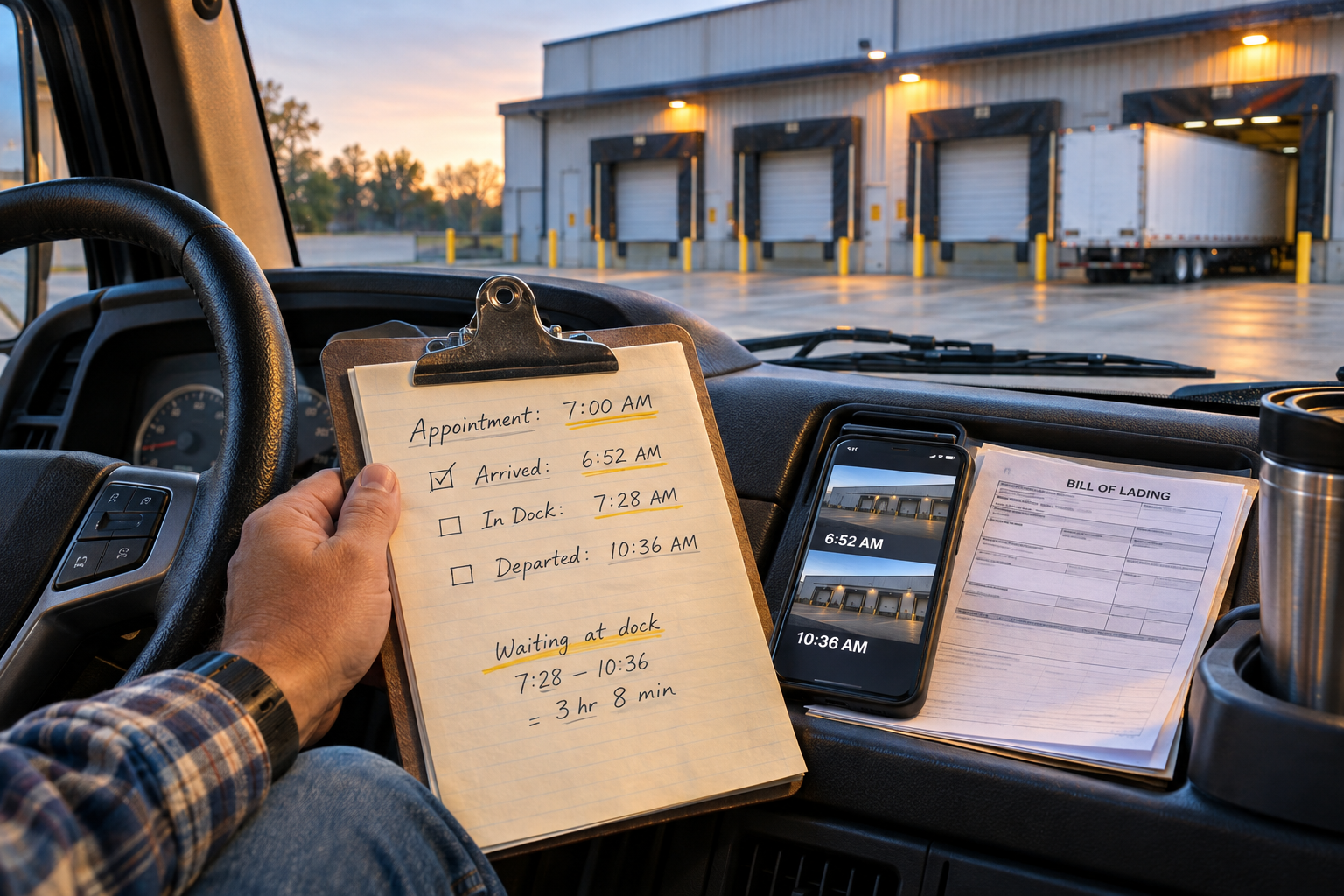
Write down the appointment time and the time you arrived. Record the facility check-in, gate-in, dock assignment, loading or unloading start, paperwork completion, gate-out, and any time dispatch or the broker was notified. If a step did not happen, note that clearly. “No dock assignment by 9:15 a.m.” is more useful than “they made me wait forever.”
Use the facility’s time zone. If your phone or ELD automatically records another zone, label it. Keep the original photo metadata or message timestamp when possible, and do not edit an image in a way that changes the record. A facility receipt with a time stamp can help. So can a check-in ticket, gate log, lumper receipt, or signed bill of lading. No single document proves everything, so keep the pieces together.
Contact dispatch or the broker as soon as the contract requires. Include the load number, facility, appointment time, current wait, and a clear question about whether detention is authorized and how they want it documented. Save the reply. If you only report the delay after leaving, the other party may question whether you followed the notice terms.
Read the load terms line by line
Find the accessorial section in the rate confirmation or broker-carrier agreement. Check:
- How much free time applies, and when the clock starts.
- Whether detention is paid by the hour, in fixed blocks, or under another formula.
- Whether there is a maximum amount or a minimum wait.
- Which event stops the clock: dock arrival, loading complete, paperwork, or gate-out.
- How quickly you must send notice and to whom.
- Which proof is required, such as a signed bill of lading or facility ticket.
- How to submit an accessorial request and when it is due.
If the rate confirmation conflicts with a master agreement, ask which term applies before the load if you can. Do not assume a verbal promise overrides written terms. Send a short written confirmation of any revised rate or accessorial instruction and save the response with the load documents.
Send a clean request, not a stack of unrelated screenshots
Put the load number and amount requested in the subject line. Attach one short timeline and the documents that support each time. Explain how you calculated the charge using the agreed terms. If a facility employee signed a receipt, include it. If you have no signature, provide the alternate evidence the contract permits and say what you were unable to obtain.
Keep the math visible. For example, if the written terms allow detention after two hours and your records show 3 hours 8 minutes from the specified start event to the specified stop event, explain the calculation and attach the timestamped records. Do not round up unless the contract says to. The actual example here is illustrative; your own rate confirmation controls.
Ask one direct question if the request is rejected: “The rate confirmation allows detention after two hours. The attached gate and release records show 3 hours 8 minutes. Which time or document does your review dispute?” That gives the reviewer something concrete to answer.
Know what public rules do and do not tell you
Federal broker recordkeeping rules are relevant to some transaction records, but they do not create a universal detention fee. Under 49 CFR 371.3, brokers must keep transaction records that include specified shipment and compensation information, including freight charges collected and the date paid to the carrier; each party to the brokered transaction has a right to review the records required by that section. The specific contract and the facts still matter when you ask about an accessorial charge.
Long waits can also affect safe scheduling. FMCSA’s hours-of-service summary describes limits for property-carrying drivers, including the 14-hour driving window and 11-hour driving limit after the required off-duty period. Do not let a detention dispute pressure you to drive beyond the rules. A 2011 GAO report described how loading and unloading delays could reduce available driving time, but it is historical research, not a current estimate of detention frequency.
Use AI to organize the file and draft the follow-up
AI can turn your notes into a timeline, compare the timeline to the accessorial clause, and list missing records. It can also misread a blurry time stamp or invent a term that is not in the contract. Remove personal, payment, and account details before using an outside tool, and check whether your broker agreement allows sharing load records.
“Review these documents for load [redacted load ID]: the rate confirmation, appointment, arrival and departure records, facility receipt, and messages. Build a chronological table with each event, time zone, source, and confidence. Compare the timeline only with the detention terms quoted below. List missing facts and questions. Do not create a rate, infer a contract term, or say the claim is legally owed. Quote the page or message for each point.”
Replace the bracketed material yourself and verify every cited timestamp against the original. Do not treat an AI summary as a substitute for the signed rate confirmation or broker response.
Illustrative example: the time stamp is there, but the notice is not
A driver has a 7 a.m. appointment and reaches the gate at 6:52. The truck is assigned a dock at 7:28 and released at 10:36. The bill of lading is signed but does not show the gate arrival. The rate confirmation requires notice to dispatch within one hour of the delay.
The driver’s gate photo and phone record support the arrival and departure times, while the signed paperwork supports release. The file is weaker on timely notice if no message went out by 8 a.m. That does not settle whether the charge is payable. It tells the driver which part to explain and what confirmation to request next time. A real claim depends on the actual contract and evidence.
Use the detention prompt book to build repeatable records
The Owner-Operator Detention Prompt Book is aimed at detention and payment disputes. It can help you turn a load’s documents into a timeline, prepare a concise accessorial request, and organize a response if the charge is denied. Use it with the terms for that specific load. It cannot set a fee, guarantee a broker will pay, or replace advice about a contract dispute.
Related guides in this series cover records that weaken a detention request, a load-to-invoice workflow, common detention questions, and templates for logs and broker follow-up.
Common questions
How long is free time before detention starts?
There is no one free-time period for every load. Read the applicable rate confirmation or agreement and identify exactly when the clock starts.
Does FMCSA require a broker to pay detention?
Do not assume that it does. The federal broker recordkeeping rule does not establish a universal detention rate. Check the written load terms and any other rules that apply to your situation.
What if the receiver refuses to sign my paperwork?
Follow the contract’s proof and notice requirements. Ask dispatch or the broker what alternate records they accept. Save gate tickets, messages, appointment records, and unaltered timestamped photos when allowed.
Should I leave the facility if the wait is long?
Follow dispatch instructions, facility safety rules, and your contract. Consider hours-of-service limits and safe parking. If leaving could affect the load, get instructions in writing where possible.
Can I use ELD records as detention proof?
They may support a timeline, but they may not show every gate, dock, or loading event. Keep them with facility receipts, messages, and load documents. Do not alter required records.
What if the broker says the request is late?
Compare the rejection with the contract’s notice and submission language. Preserve the original message and ask which deadline or missing record applies. If the disputed amount is significant, seek qualified help.
Sources and scope
- 49 CFR 371.3, Records to be kept by brokers. Federal broker recordkeeping requirements.
- FMCSA, Summary of Hours of Service Regulations. Federal HOS summary for property and passenger carriers.
- U.S. Government Accountability Office, GAO-11-198. Historical 2011 report on loading and unloading wait times and hours-of-service concerns.
Last reviewed: November 16, 2026. Contract terms determine whether a detention charge is available and how to claim it. This article is general information, not legal advice. Get qualified help for a contract dispute or threatened claim.
